
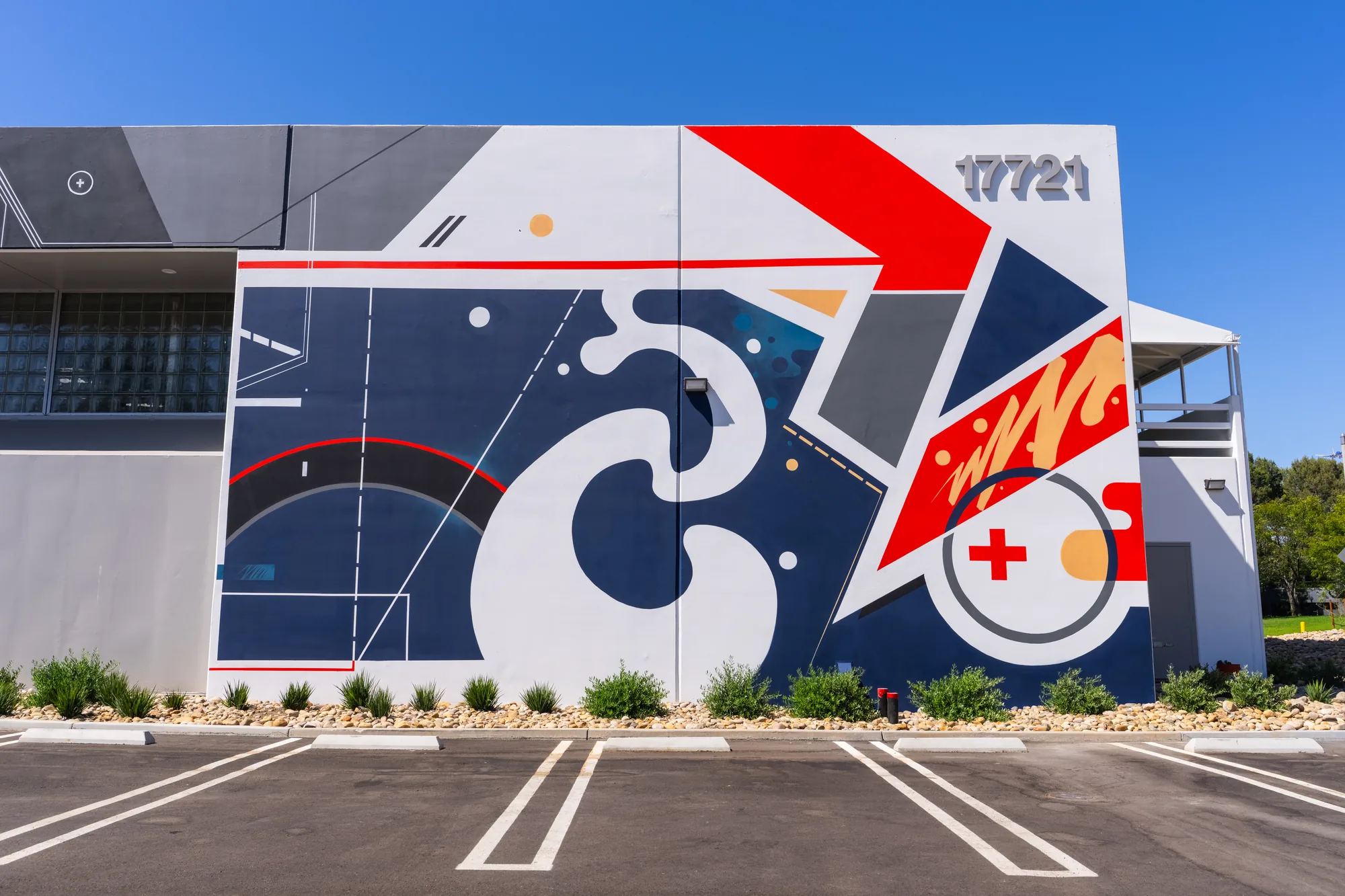
Hand-painted murals for real estate and property developments across Los Angeles: apartment buildings, condominiums, mixed-use and master-planned projects, office parks, retail centers and parking structures, and the lobbies, amenity spaces, courtyards and exteriors inside them. We work with developers, owners, property managers and HOA boards. Projects start at $7,500, and because we quote per project rather than per wall, a development that treats several areas as one commission pays considerably less than doing them piecemeal.
A mural is one of the few capital improvements that changes how a property is perceived on the day it is finished. It gives a new development an identity before the landscaping has grown in, gives an older building a reason to be photographed again, and gives a whole project a landmark that people use to find it.
Why developers and property teams commission murals
Identity for a new development. A new project opens as a set of renderings made real, and for the first year it competes on finishes and location alone. A commissioned mural gives it a face: something people photograph, tag and describe when they explain where they live or work. For lease-up and sales it is one of the few investments that reads as complete on day one and photographs well before the building is full.
Differentiation where everything else is the same. Amenity spend across a submarket is competitive and largely undifferentiated. Every building has a gym, a lounge and a pool deck, and prospects tour three of them in an afternoon. What they remember afterwards is rarely the equipment list. A mural makes one property visually distinct in a way that carries into the listing photos, which are the other half of the decision.
Repositioning an older asset. A tired lobby, a grim parking structure or a blank street wall can be transformed for a fraction of a renovation budget, and the change is visible from the sidewalk. The Omen AI building shows what a painted exterior does to an anonymous low-rise in an office park.
Public art obligations. Several cities in the region ask larger developments to fund or install public art, and in some of them a permanent on-site artwork such as a mural can count toward that requirement instead of a fee. The rules differ city by city and we confirm them with the planning department on every project, but it is worth raising with your consultant before the art budget is spent elsewhere.
Placemaking for a whole project. On a master-planned or mixed-use site, a set of murals across garages, paseos and building ends gives the development a shared visual language that signage cannot, and gives residents and tenants something to be proud of.
Where murals earn their keep on a property
Lobbies, leasing offices and sales centers. The first room every prospect sees and the backdrop of every tour photo. Usually one strong feature wall rather than wall-to-wall treatment.
Amenity rooms, lounges and resident gyms. High-traffic, heavily photographed spaces where a painted wall replaces the standard decal look entirely. The specifics of painting fitness spaces are on our gym murals page.
Pool decks, courtyards and paseos. Exterior work that has to survive sun, chlorine, sprinklers and constant use. This is a specification question more than an artistic one, and it is where cheap jobs fail within two summers.
Parking structures and podium walls. Consistently the best value on any property. They are enormous, everyone passes through them daily, they are usually grim, and expectations are low enough that any real artwork transforms them. Our Flawless Kustoms and YMD truck garage projects show what that surface can carry.
Building exteriors and street frontage. The biggest statement, and the one that makes a building a landmark in its neighborhood. Inside the City of Los Angeles these require registration before painting, which our permit guide covers, and most surrounding cities are lighter.
Construction hoardings. A painted hoarding turns eighteen months of plywood into the first piece of marketing a project has, and it is temporary by design, so it can carry the project name and brand freely.
Working around residents, tenants and construction schedules
Occupied properties have constraints a construction site does not. Amenity spaces cannot be closed for a week, corridors have to stay passable, and noise and odor complaints reach the management office directly. We schedule around that: work in sections rather than closing a whole room, screened and floor-protected, using low-odor products so a space is usable again the next day. Parking structures are painted level by level or bay by bay so nobody loses access. We give the property manager a schedule specific enough to put in a resident or tenant notice, and we keep to it, because the notice is the manager’s credibility, not just ours.
On new construction we slot into the general contractor’s schedule, usually after the final coat of building paint and before furniture and fixtures arrive, and we coordinate access, hot-work rules and site safety with the superintendent like any other trade. Our guide to how long a mural takes sets out realistic timelines for both situations.
Durability in common areas
Common-area walls take abuse that a private office wall never sees: carts, bikes, furniture, cleaning chemicals and, on exteriors, weather and occasional tagging. We specify for that rather than hoping. Interior work in high-contact zones is sealed so it can be cleaned without lifting. Exterior work uses UV-resistant paint and a protective anti-graffiti coating, which means a tag is washed off rather than painted over. That single detail is the difference between a mural that survives a decade on a parking structure and one that gets patched into ruin in year two. Our page on how long a mural lasts goes through the coatings in detail.
Portfolios, phases and repeat work
Owners and managers running several properties, and developers building in phases, are our most straightforward clients, because the second and third projects go faster than the first. We keep a consistent approach across a portfolio or a multi-phase site while giving each building its own artwork, which is the point: identical graphics across buildings is a printing job, and we say so. Our comparison with vinyl wraps is honest about where that line sits.
For budgeting, the 2026 Los Angeles mural pricing guide has real numbers by scale and surface. Multi-area commissions on one property are quoted as a single project, and corporate campuses and office interiors have their own page: office and corporate murals.
Real estate and development mural questions
What does a mural cost for a property or development?
A single feature wall generally starts around $7,500. Larger walls, parking structures, multi-area programs and full building exteriors go up from there depending on scale, surface and access. Several areas commissioned together are quoted as one project and cost less than doing them separately.
When in a development should the mural be planned?
Early enough to sit in the finishes schedule and the art budget: ideally at design development, so walls, lighting and sightlines are chosen with it in mind. Painting itself happens after the final building paint and before furniture arrives. Construction hoardings can be painted from day one of the build.
Can a mural count toward a public art requirement?
In some cities, yes: a permanent on-site artwork can satisfy a development’s public art obligation instead of an in-lieu fee. Requirements differ by city and by project size, so we confirm with the planning department before anything is designed.
Do residents or tenants lose access while you paint?
No. We work in sections rather than closing whole spaces, screened and floor-protected, with low-odor products so a room is usable the next day. Parking structures are painted level by level. You get a schedule precise enough to put straight into a notice.
Which space gives the best return?
Lobbies and amenity spaces for tour and listing impact, parking structures for the most change per dollar, and street-facing exteriors for making the building a landmark. Podium and garage walls are large, seen daily, usually grim, and the transformation is dramatic for the money.
Will it survive a high-traffic common area?
Yes, when specified properly. Interior work in high-contact zones is sealed so it can be cleaned without lifting. Exteriors get UV-resistant paint plus an anti-graffiti coating, so tags wash off instead of requiring repainting.
Can you match our brand or design standards?
Yes. Concept, palette and style are built around your brief and the building, and you approve a rendered preview on a photograph of the actual wall before painting begins. That preview is also what ownership, HOA boards and design review committees sign off on.
Do you work across a portfolio or several phases?
Regularly, and it gets easier after the first property. We keep a consistent standard across a portfolio or a phased development while giving each building its own artwork. If you genuinely need identical graphics at every location, that is a printing job and we will tell you so.